 Deliver to
United Kingdom
Deliver to
United Kingdom

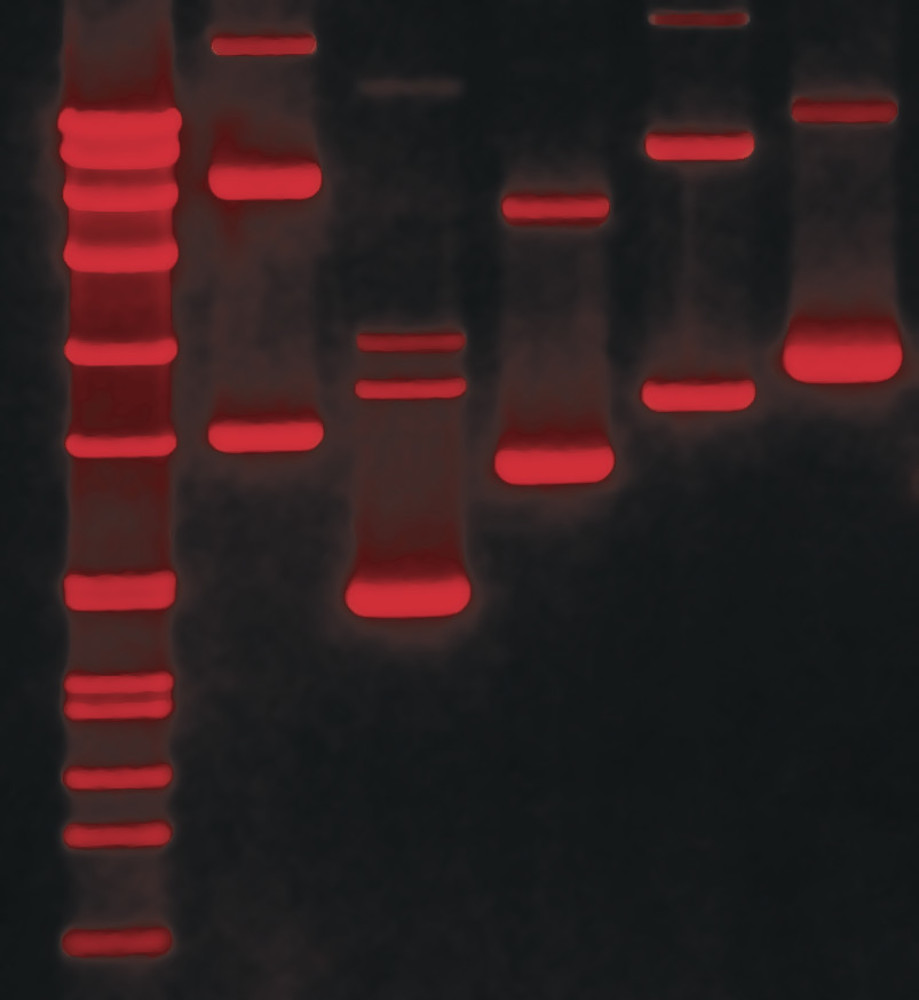
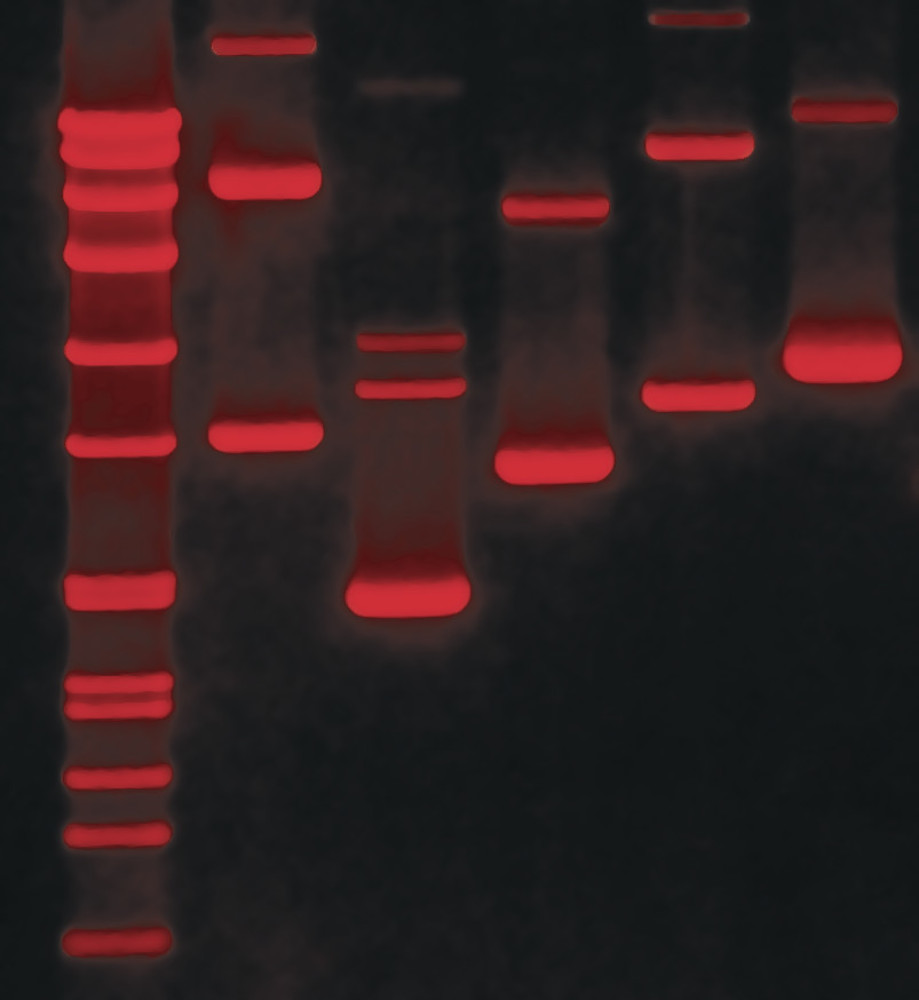

Non-toxic and non-carcinogenic dyes for fluorescent staining of nucleic acids in agarose gels and polyacrylamide gels. Highly sensitive and applied just like ethidium bromide. The ROTI ® GelStain dyes are used as additives to the gel solution and the running buffer, partly also post-run staining is possible. Both ROTI ® GelStain dyes can be excited by UV light and by blue light. Resulting signals may be detected by ethidium bromide broadband photo filters. ROTI ® GelStain Red Eco 10 000x conc., ready-to-use ROTI ® GelStain Red Eco is a versatile staining reagent for the detection of all nucleic acids in agarose and polyacrylamide gels. Properties: Red fluorescence Alternative to ethidium bromide, non-toxic, non-mutagenic For staining of dsDNA, ssDNA and RNA Twice as sensitive as ethidium bromide (approx. 0.1 ng /band) Can be used with the common ethidium bromide filters Excitation with UV light (300 nm) and blue light (500 nm) Compatible with all common downstream applications ROTI ® GelStain Red Eco is a red fluorescent dye which, like ethidium bromide, can be used to stain nucleic acids. For this purpose, the dye can either be added directly to the gel solution or used for post-run staining. With the Ames test, it could be proven that ROTI ® GelStain Red Ecois significantly less toxic than ethidium bromide. At the same time, the dye is twice as sensitive as ethidium bromide (approx. 0.1 ng/band). The red fluorescence of the dye can be documented with all common ethidium bromide photofilters. ROTI ® GelStain Red Eco is compatible with all common downstream applications. Advantages: More sensitive than ethidium bromide and ROTI ® GelStain Red (0984.1) Dissolved in water instead of DMSO Also suitable for post-run staining Wavelength Excitation maximum (bound to DNA): approx. 300 nm and 500 nm Emission maximum (bound to DNA): 600 nm. Not a medical device / Not an IVD product
Product Detail
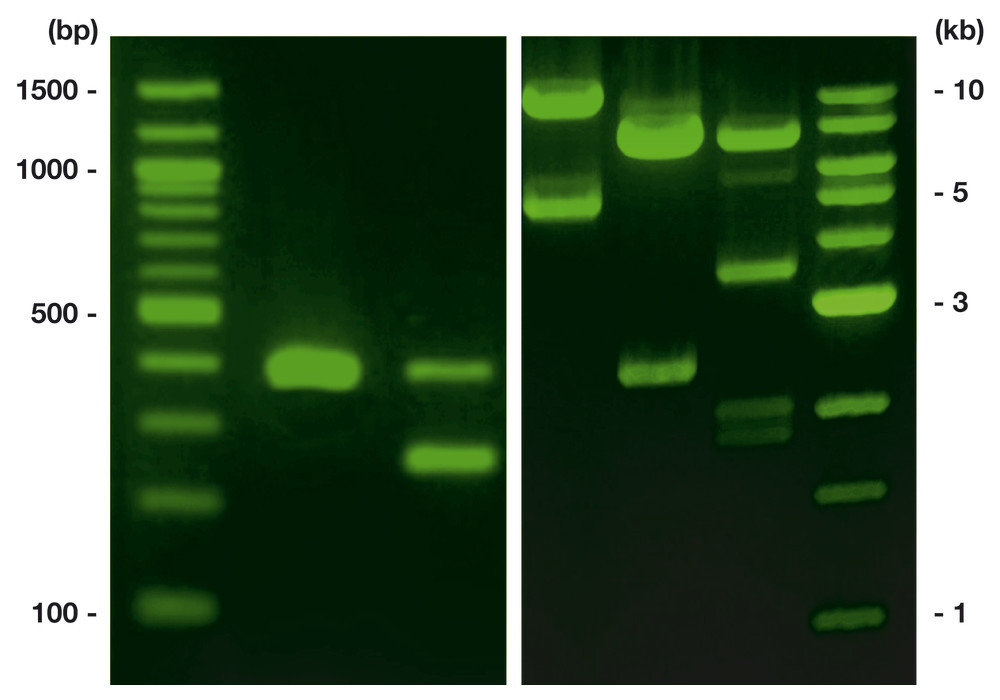
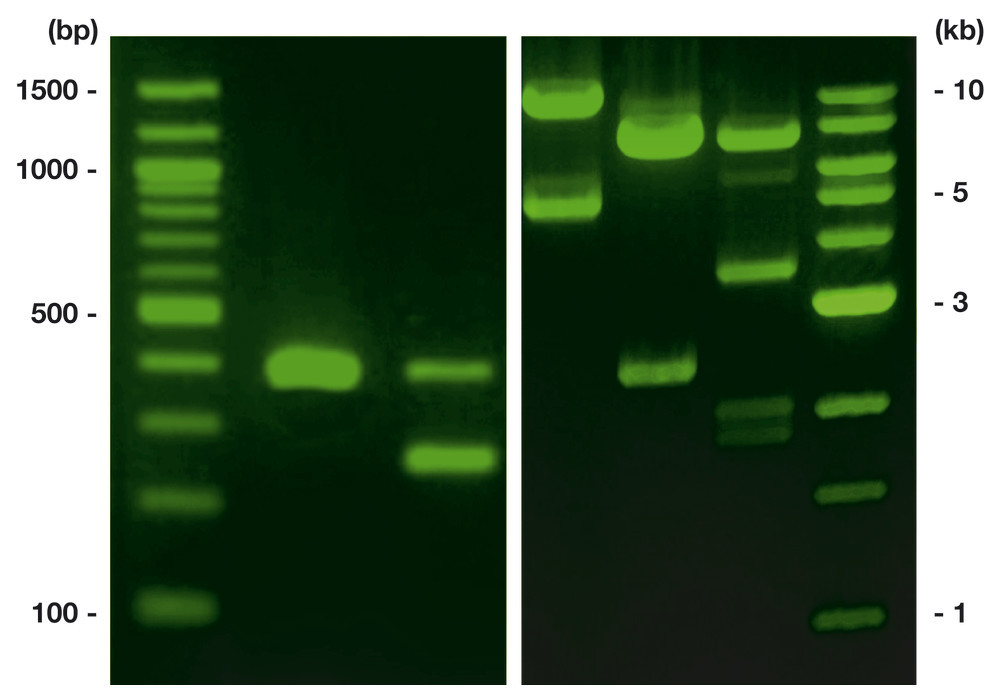
Non-toxic and non-carcinogenic dyes for fluorescent staining of nucleic acids in agarose gels and polyacrylamide gels. Highly sensitive and applied just like ethidium bromide. The ROTI ® GelStain dyes are used as additives to the gel solution and the running buffer, partly also post-run staining is possible. Both ROTI ® GelStain dyes can be excited by UV light and by blue light. Resulting signals may be detected by ethidium bromide broadband photo filters. ROTI ® GelStain 20 000x conc., ready-to-use ROTI ® GelStain is a versatile staining reagent for detection of all nucleic acids in agarose and polyacrylamide gels. Green fluorescence Alternative for ethidium bromide, non-toxic and non-mutagenic For dsDNA, ssDNA and RNA Sensitivity comparable to ethidium bromide (approx. 0.3 ng / band) For use with common broad-band ethidium bromide photo filters Excitation via UV light (302 nm) and blue light (490 nm) Compatible with all usual down-stream applications The dye can be used in a similar manner as ethidium bromide. By adding the dye to the liquid gel, the nucleic acids are stained during the gel run. ROTI ® GelStain has a sensitivity of 0.2 ng/band and is thus even slightly more sensitive than ethidium bromide. When bound to nucleic acids in agarose gels, ROTI ® GelStain emits a brightly green fluorescence that may be documented by all usual broadband ethidium bromide or SYBR ® Green foto filters. ROTI ® -GelStain is compatible with all standard down-stream applications and has been successfully tested for use with gel extraction, ligation, transformation and transfection. Wavelength Excitation maximum (bound to DNA): 302 nm (UV) and 490 nm (blue light) Emission maximum (bound to DNA): 520 nm Figure: Amplicons of a mouse genotyping (left), and restriction digested DNA (right), respectively, separated in 2,5 and 1 % agarose ROTI ® garose NEEO with ROTI ® GelStain (5 µl / 100 ml agarose). Pictures were taken using standard ethidium bromide photo filters. With kind permission of Prof. R. Slany, Dept. of Genetics, Friedrich Alexander University, Erlangen.
Product Detail
Non-toxic and non-carcinogenic dyes for fluorescent staining of nucleic acids in agarose gels and polyacrylamide gels. Highly sensitive and applied just like ethidium bromide. The ROTI ® GelStain dyes are used as additives to the gel solution and the running buffer, partly also post-run staining is possible. Both ROTI ® GelStain dyes can be excited by UV light and by blue light. Resulting signals may be detected by ethidium bromide broadband photo filters. ROTI ® GelStain Red Eco 10 000x conc., ready-to-use ROTI ® GelStain Red Eco is a versatile staining reagent for the detection of all nucleic acids in agarose and polyacrylamide gels. Properties: Red fluorescence Alternative to ethidium bromide, non-toxic, non-mutagenic For staining of dsDNA, ssDNA and RNA Twice as sensitive as ethidium bromide (approx. 0.1 ng /band) Can be used with the common ethidium bromide filters Excitation with UV light (300 nm) and blue light (500 nm) Compatible with all common downstream applications ROTI ® GelStain Red Eco is a red fluorescent dye which, like ethidium bromide, can be used to stain nucleic acids. For this purpose, the dye can either be added directly to the gel solution or used for post-run staining. With the Ames test, it could be proven that ROTI ® GelStain Red Ecois significantly less toxic than ethidium bromide. At the same time, the dye is twice as sensitive as ethidium bromide (approx. 0.1 ng/band). The red fluorescence of the dye can be documented with all common ethidium bromide photofilters. ROTI ® GelStain Red Eco is compatible with all common downstream applications. Advantages: More sensitive than ethidium bromide and ROTI ® GelStain Red (0984.1) Dissolved in water instead of DMSO Also suitable for post-run staining Wavelength Excitation maximum (bound to DNA): approx. 300 nm and 500 nm Emission maximum (bound to DNA): 600 nm. Not a medical device / Not an IVD product
Product Detail
Non-toxic and non-carcinogenic dyes for fluorescent staining of nucleic acids in agarose gels and polyacrylamide gels. Highly sensitive and applied just like ethidium bromide. The ROTI ® GelStain dyes are used as additives to the gel solution and the running buffer, partly also post-run staining is possible. Both ROTI ® GelStain dyes can be excited by UV light and by blue light. Resulting signals may be detected by ethidium bromide broadband photo filters. ROTI ® GelStain 20 000x conc., ready-to-use ROTI ® GelStain is a versatile staining reagent for detection of all nucleic acids in agarose and polyacrylamide gels. Green fluorescence Alternative for ethidium bromide, non-toxic and non-mutagenic For dsDNA, ssDNA and RNA Sensitivity comparable to ethidium bromide (approx. 0.3 ng / band) For use with common broad-band ethidium bromide photo filters Excitation via UV light (302 nm) and blue light (490 nm) Compatible with all usual down-stream applications The dye can be used in a similar manner as ethidium bromide. By adding the dye to the liquid gel, the nucleic acids are stained during the gel run. ROTI ® GelStain has a sensitivity of 0.2 ng/band and is thus even slightly more sensitive than ethidium bromide. When bound to nucleic acids in agarose gels, ROTI ® GelStain emits a brightly green fluorescence that may be documented by all usual broadband ethidium bromide or SYBR ® Green foto filters. ROTI ® -GelStain is compatible with all standard down-stream applications and has been successfully tested for use with gel extraction, ligation, transformation and transfection. Wavelength Excitation maximum (bound to DNA): 302 nm (UV) and 490 nm (blue light) Emission maximum (bound to DNA): 520 nm Figure: Amplicons of a mouse genotyping (left), and restriction digested DNA (right), respectively, separated in 2,5 and 1 % agarose ROTI ® garose NEEO with ROTI ® GelStain (5 µl / 100 ml agarose). Pictures were taken using standard ethidium bromide photo filters. With kind permission of Prof. R. Slany, Dept. of Genetics, Friedrich Alexander University, Erlangen.
Product Detail
Non-toxic and non-carcinogenic dyes for fluorescent staining of nucleic acids in agarose gels and polyacrylamide gels. Highly sensitive and applied just like ethidium bromide. The ROTI ® GelStain dyes are used as additives to the gel solution and the running buffer, partly also post-run staining is possible. Both ROTI ® GelStain dyes can be excited by UV light and by blue light. Resulting signals may be detected by ethidium bromide broadband photo filters. ROTI ® GelStain Advanced 20 000x conc., ready-to-use ROTI ® GelStain Advanced is a versatile staining reagent for the detection of all nucleic acids in agarose and polyacrylamide gels. Properties: Simple differentiation between DNA and RNA by characteristic fluorescence: green for DNA and red for RNA Alternative to ethidium bromide, non-toxic, non-mutagenic Up to 4 x as sensitive as ethidium bromide (approx. 0.1 ng/band) Can be used with the usual green filters Excitation with UV light (300 nm) and blue light (500 nm) possibleCompatible with all common down-stream applications ROTI ® GelStain Advanced is a green fluorescent dye for nucleid acid staining like ethidium bromide. The nucleic acids are stained during the gel run after adding the dye to the liquid gel and the running buffer. ROTI ® GelStain Advanced has a sensitivity of 0.1 ng/band and is up to 4 x more sensitive than ethidium bromide. After binding to the nucleic acid in the agarose gel, ROTI ® GelStain Advanced emits a bright green fluorescence when bound to DNA and a bright red fluorescence when bound to RNA. The fluorescence can be documented with all common green filters. ROTI ® GelStain Advanced is compatible with all common down-stream applications. Wavelength Excitation maximum (bound to DNA): 490 nm Emission maximum (bound to DNA): 520 nm Emission maximum (bound to RNA): 635 nm Not a medical device / Not an IVD product
Product Detail
Non-toxic and non-carcinogenic dyes for fluorescent staining of nucleic acids in agarose gels and polyacrylamide gels. Highly sensitive and applied just like ethidium bromide. The ROTI ® GelStain dyes are used as additives to the gel solution and the running buffer, partly also post-run staining is possible. Both ROTI ® GelStain dyes can be excited by UV light and by blue light. Resulting signals may be detected by ethidium bromide broadband photo filters. ROTI ® GelStain Advanced 20 000x conc., ready-to-use ROTI ® GelStain Advanced is a versatile staining reagent for the detection of all nucleic acids in agarose and polyacrylamide gels. Properties: Simple differentiation between DNA and RNA by characteristic fluorescence: green for DNA and red for RNA Alternative to ethidium bromide, non-toxic, non-mutagenic Up to 4 x as sensitive as ethidium bromide (approx. 0.1 ng/band) Can be used with the usual green filters Excitation with UV light (300 nm) and blue light (500 nm) possibleCompatible with all common down-stream applications ROTI ® GelStain Advanced is a green fluorescent dye for nucleid acid staining like ethidium bromide. The nucleic acids are stained during the gel run after adding the dye to the liquid gel and the running buffer. ROTI ® GelStain Advanced has a sensitivity of 0.1 ng/band and is up to 4 x more sensitive than ethidium bromide. After binding to the nucleic acid in the agarose gel, ROTI ® GelStain Advanced emits a bright green fluorescence when bound to DNA and a bright red fluorescence when bound to RNA. The fluorescence can be documented with all common green filters. ROTI ® GelStain Advanced is compatible with all common down-stream applications. Wavelength Excitation maximum (bound to DNA): 490 nm Emission maximum (bound to DNA): 520 nm Emission maximum (bound to RNA): 635 nm Not a medical device / Not an IVD product
Product Detail© 2023 Copyright. All Rights Reserved. Unit 19, Euroway House, Roydsdale Way, Bradford, BD4 6SE, UK





© 2023 Copyright. All Rights Reserved. Unit 19, Euroway House, Roydsdale Way, Bradford, BD4 6SE, UK

