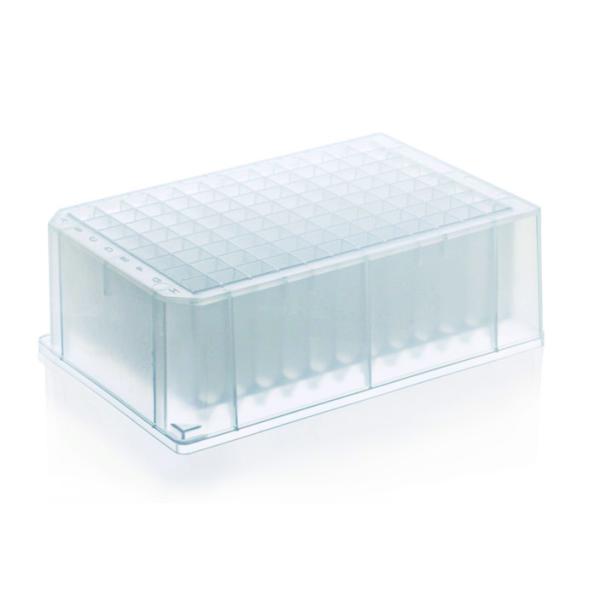
Deep-well plates: The most important application for deep-well plates is sample storage. They are also an important component in numerous other applications, e. g. cultivation of microorganisms, extraction of nucleic acids and proteins, screening studies etc. - Free from DNA, RNases, and DNases. - High chemical resistance, e. g. against DMSO. - Temperature range - 80 to + 121 °C. - Acc. to ANSI / SLAS 1 and 4. - Stackable. - The 1.2 ml low profile model reduces the space requirements by approx. 30 %. - Deep-well plate 384 well is designed for a wide range of applications, such as High-Throughput Screening (HTS), tests requiring a mother plate, cell and tissue cultures, serial dilutions, reagent transfer and sample storage down - 80 °C etc. Cover mats for deep-well plates: Cover mats reduce the max. volume of wells. Adhesive sealing films can also be used. Deep-well plates: The most important application for deep-well plates is sample storage. They are also an important component in numerous other applications, e. g. cultivation of microorganisms, extraction of nucleic acids and proteins, screening studies etc. - Free from DNA, RNases, and DNases. - High chemical resistance, e. g. against DMSO. - Temperature range - 80 to + 121 °C. - Acc. to ANSI / SLAS 1 and 4. - Stackable. - The 1.2 ml low profile model reduces the space requirements by approx. 30 %. - Deep-well plate 384 well is designed for a wide range of applications, such as High-Throughput Screening (HTS), tests requiring a mother plate, cell and tissue cultures, serial dilutions, reagent transfer and sample storage down - 80 °C etc. Cover mats for deep-well plates: Cover mats reduce the max. volume of wells. Adhesive sealing films can also be used.
 Deliver to
United Kingdom
Deliver to
United Kingdom