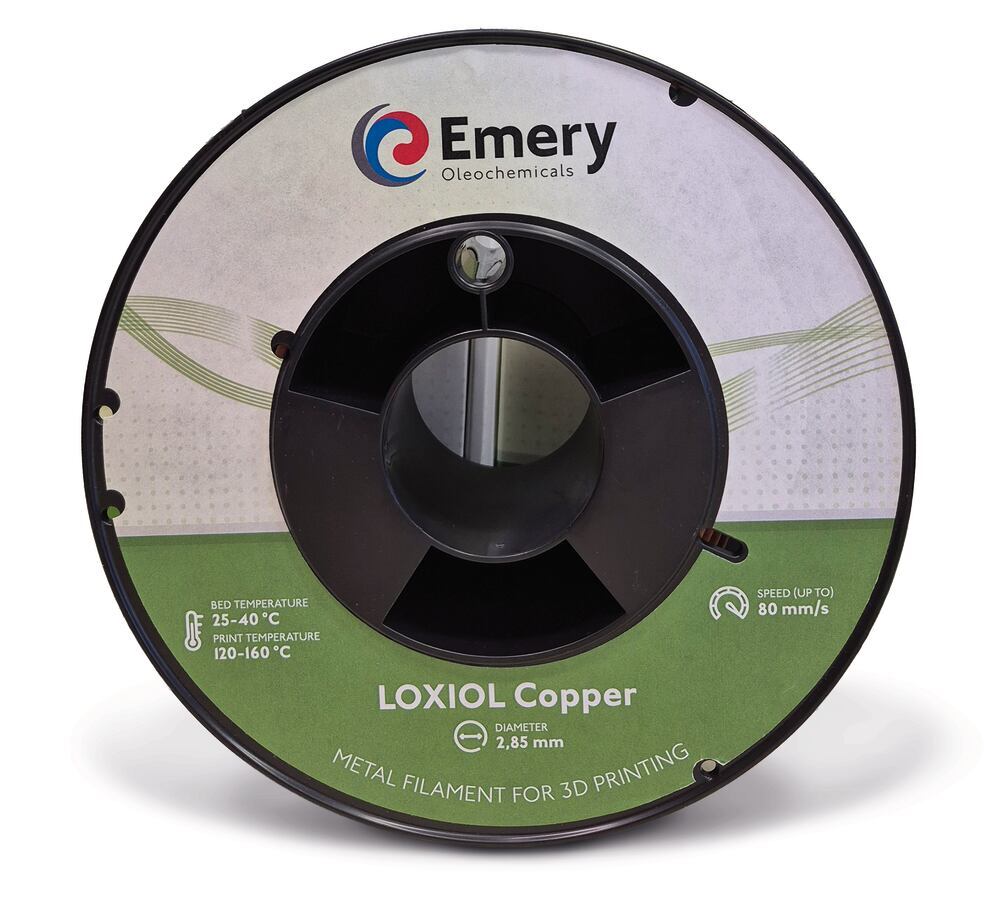
LOXIOL represents high-quality metal filaments specifically developed for additive manufacturing (3D printing). The product range enables the production of high-quality, robust, and precise metal components. LOXIOL filaments offer excellent mechanical properties, corrosion resistance, and versatility, making them ideal for industrial and technical applications. Loxiol Copper Copper Filament for Electrically and Thermally Conductive Components LOXIOL Copper offers excellent thermal and electrical conductivity, combined with the precision of additive manufacturing. Advantages: High electrical conductivity Optimal heat dissipation Suitable for functional prototypes and electronic components Directions for use Notes on Printing Parameters and Thermal Management The recommended printing parameters for processing this filament are specified in the corresponding technical data sheet and must be strictly followed to ensure reliable and reproducible print quality. Due to the filament’s high thermal conductivity, insufficient cooling by the fan may cause heat to be conducted back into the extruder. This can lead to premature softening of the filament in the feed path, which may ultimately result in increased wear and feeding issues. To minimize this risk, it is recommended to operate the hotend fan continuously at 100% power and to start printing with the lowest possible nozzle temperature. This reduces the amount of heat that needs to be dissipated and ensures a stable and consistent material flow. Please note Post-Processing After 3D Printing After 3D printing, the components are present as so-called green parts, in which the metal powder is held together by a polymer binder system. To obtain a pure metal part, downstream thermal processes are required. The first step is debinding, during which the binder system is removed in a controlled manner. This is followed by sintering, where the components are heated to high temperatures. During this process, the metal particles fuse together, the part densifies, and it achieves its final mechanical properties. After sintering, the result is a nearly fully dense metal component with high strength and dimensional accuracy. Further information on the debinding and sintering process can be found in the technical data sheet.

 Deliver to
United Kingdom
Deliver to
United Kingdom
 TIB-VAR-2773010-EN