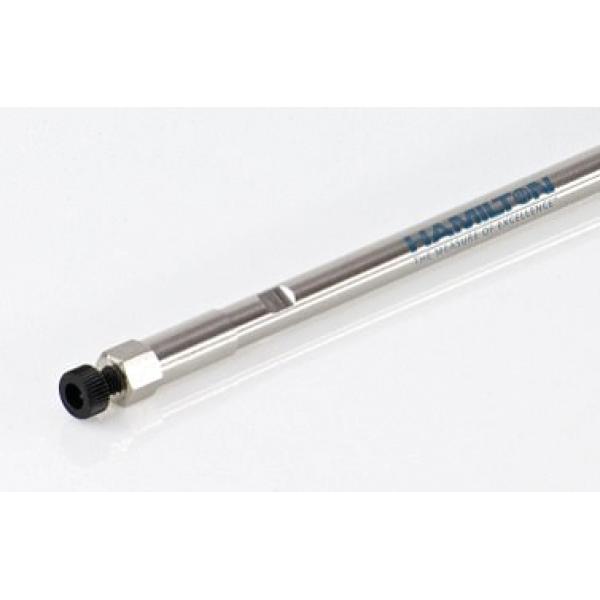
For the efficient analysis of standard anions in complex matrices. HAMILTON PRP-X100 and X110 ion exchange columns are the easy way to separate all common inorganic and organic anions. The optimised packing material consists of cross-linked polystyrene-divinylbenzene particles (PSDVB). Trimethylammonium (TMA) anion exchange groups are grafted to the surface of PSDVB. These covalently bound active sites are the reason for the unmatched durability of the Hamilton columns, even if they are used under difficult operating conditions. The determination of anions in complex or dirty matrices may be performed without elaborative sample preparation due to the optimised particle architecture and the high exchange capacity of about 319 meq / column (4.6 x 250 mm) for PRP-X100 and 185 meq / column (4.6 x 250 mm) for PRP-X110. In addition, a wide range of different applications is addressed by the complementary retention characteristics of both column models. - High resolution separation of standard anions in a concentration range of 0.01 and 500 ppm (PRP-X100) resp. 0.02 and 200 ppm (PRP-X110). - EPA 300.0 compliance. - Carbonate, hydroxide or benzoic acid buffer as well as up to 100 % organic possible. - Conductivity detection with and without suppressor. - Use in all common IC and standard HPLC systems (compatible with indirect UV detection). - pH stability from 1 to 13 - increased lifetime, cleaning under harsh conditions possible. - Compatible with complex matrices. - High flexibility due to various lengths, Ø and particle sizes. For the efficient analysis of standard anions in complex matrices. HAMILTON PRP-X100 and X110 ion exchange columns are the easy way to separate all common inorganic and organic anions. The optimised packing material consists of cross-linked polystyrene-divinylbenzene particles (PSDVB). Trimethylammonium (TMA) anion exchange groups are grafted to the surface of PSDVB. These covalently bound active sites are the reason for the unmatched durability of the Hamilton columns, even if they are used under difficult operating conditions. The determination of anions in complex or dirty matrices may be performed without elaborative sample preparation due to the optimised particle architecture and the high exchange capacity of about 319 meq / column (4.6 x 250 mm) for PRP-X100 and 185 meq / column (4.6 x 250 mm) for PRP-X110. In addition, a wide range of different applications is addressed by the complementary retention characteristics of both column models. - High resolution separation of standard anions in a concentration range of 0.01 and 500 ppm (PRP-X100) resp. 0.02 and 200 ppm (PRP-X110). - EPA 300.0 compliance. - Carbonate, hydroxide or benzoic acid buffer as well as up to 100 % organic possible. - Conductivity detection with and without suppressor. - Use in all common IC and standard HPLC systems (compatible with indirect UV detection). - pH stability from 1 to 13 - increased lifetime, cleaning under harsh conditions possible. - Compatible with complex matrices. - High flexibility due to various lengths, Ø and particle sizes.

 Deliver to
United Kingdom
Deliver to
United Kingdom