Deliver to United Kingdom
0
Products Found: 6
Showing Results For: Ethium bromide

Ethium bromide


HP47.1, Carl Roth

MF Part: HP47.1
MOQ: 1 - 5
£ 38.61
In Stock
more details

1239-45-8, Carl Roth

MF Part: 1239-45-8
MOQ: 1 - 5
£ 40.55
In Stock
more details

HP47.2, Carl Roth

MF Part: HP47.2
MOQ: 1 - 5
£ 130.64
In Stock
more details

1239-45-8, Carl Roth

MF Part: 1239-45-8
MOQ: 1 - 5
£ 31.46
In Stock
more details

1239-45-8, Carl Roth

MF Part: 1239-45-8
MOQ: 1 - 5
£ 14.04
In Stock
more details

1239-45-8, Carl Roth

MF Part: 1239-45-8
MOQ: 1 - 5
£ 78.89
In Stock
more details

New Items
New
HP47.1, Carl Roth

HP47.1, Carl Roth

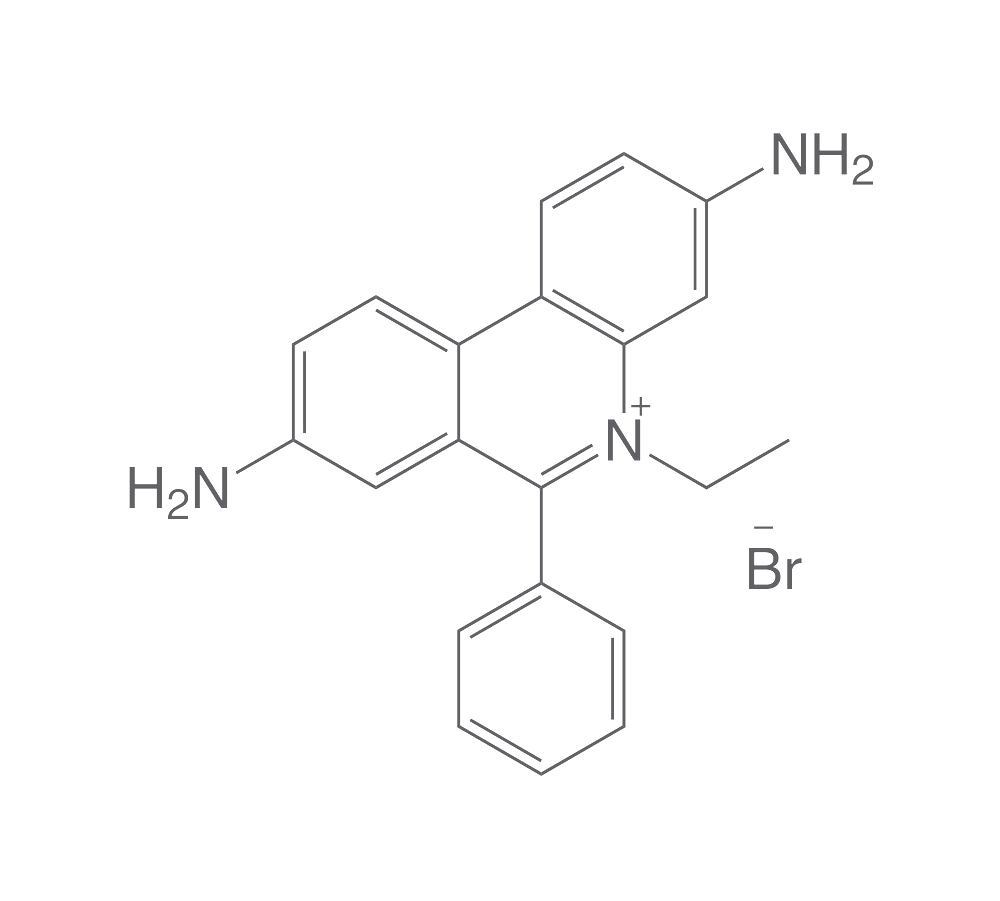
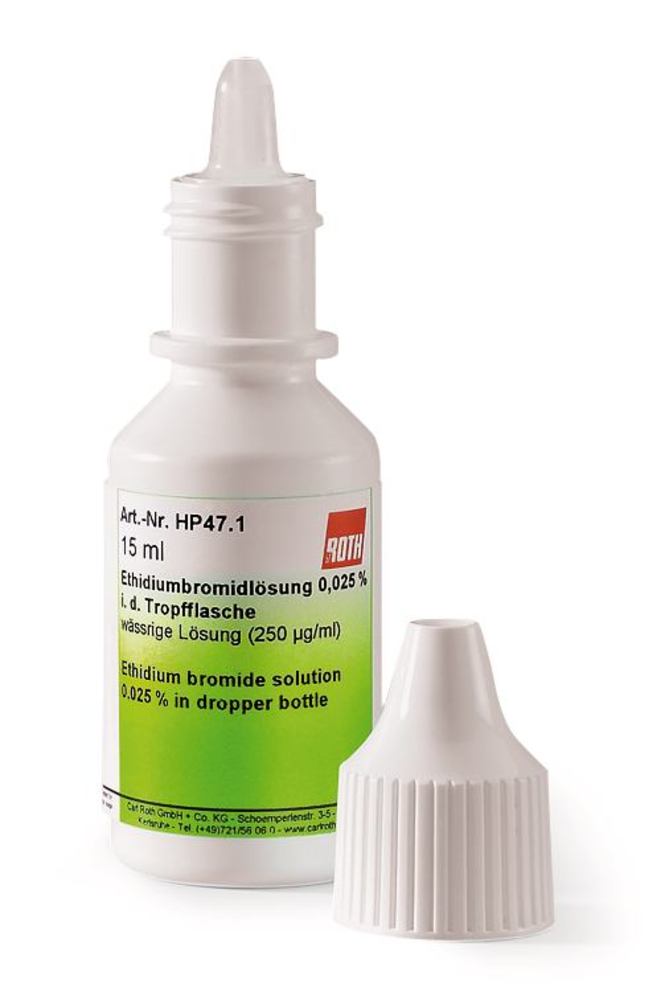
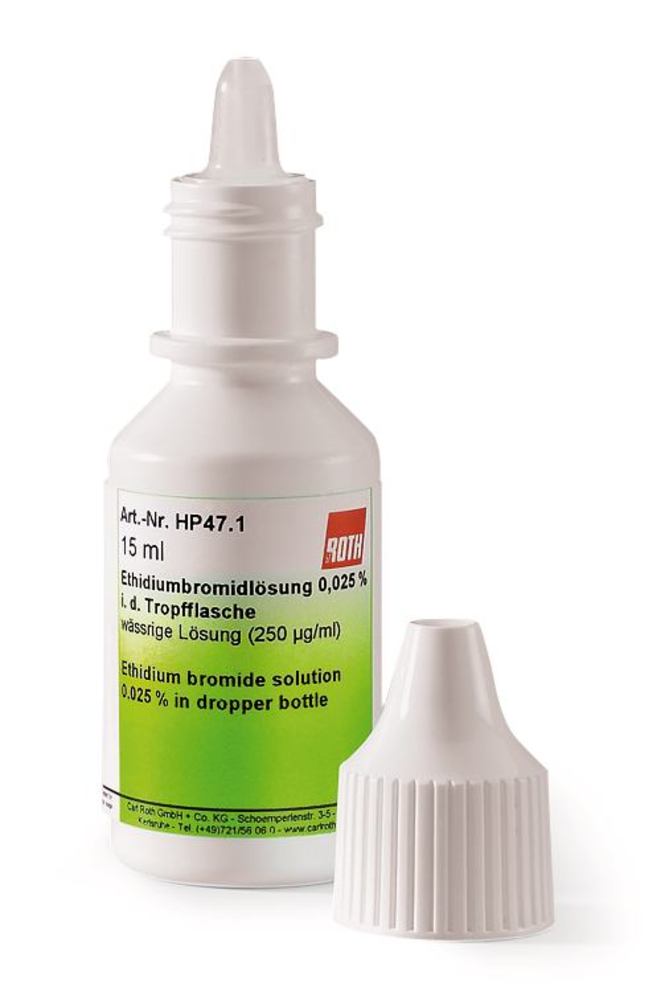
In spite of newly developed fluorescent staining reagents ethidium bromide remains the standard staining technic for nucleic acid in electrophoresis. Ethidium bromide is a carcinogenic substance which shouldn’t come in contact with skin. In order to minimise this danger we offer ready-to-use ethidium bromide solutions in dropper bottles for easy handling and maximum safety. Wavelength Excitation maxima (unbound): 210 nm, 285 nm, 470 nm Excitation maxima (bound to DNA): 330 nm, 500 nm. Excitation possible via DNA at 254 nm Emission maximum: 605 nm. Ethidium bromide Ethidium bromide is a strong mutagenic and toxic substance. For your own safety, always wear gloves and respiratory protection to prevent contamination when working with this substance. After use, dispose of solutions correctly. They may not be discarded into the environment. The following procedure is recommended (acc. to INSERM, Dossier prevention, Number 2, 2nd Ed., September 88): 1. Collect and dispose of as hazardous waste. 2. Break down EtBr with potassium permanganate and HCI (P. Quillardet, M. Hofnung, Trends Genet . 4,89 [1988]). 3. Break down EtBr with hypophosphoric acid and sodium nitrite (Lunn and Sansone; Analyt. Biochem. 162, 453-458 [1987]). 4. Absorption of EtBr with Amberlite ® XAD-16 (Lunn and Sansone) or with activated carbon (Bensaude, O. Method, Trends Genet. 4, 89-90 [1988]) from the solution. We recomment disposure by SEKUROKA ® Decon-Bags (Art. No. T856) Ethidium bromide solution 0.025 % in dropper bottle 250 μg/ml in water, ready-to-use Directions for use Two drops will suffice for staining a 50 ml agarose gel. Add directly to melted agarose.

Product Detail
New
1239-45-8, Carl Roth

1239-45-8, Carl Roth

Wavelength Excitation maxima (unbound): 210 nm, 285 nm, 470 nm Excitation maxima (bound to DNA): 330 nm, 500 nm. Excitation possible via DNA at 254 nm Emission maximum: 605 nm. Ethidium bromide Ethidium bromide is a strong mutagenic and toxic substance. For your own safety, always wear gloves and respiratory protection to prevent contamination when working with this substance. After use, dispose of solutions correctly. They may not be discarded into the environment. The following procedure is recommended (acc. to INSERM, Dossier prevention, Number 2, 2nd Ed., September 88): 1. Collect and dispose of as hazardous waste. 2. Break down EtBr with potassium permanganate and HCI (P. Quillardet, M. Hofnung, Trends Genet . 4,89 [1988]). 3. Break down EtBr with hypophosphoric acid and sodium nitrite (Lunn and Sansone; Analyt. Biochem. 162, 453-458 [1987]). 4. Absorption of EtBr with Amberlite ® XAD-16 (Lunn and Sansone) or with activated carbon (Bensaude, O. Method, Trends Genet. 4, 89-90 [1988]) from the solution. We recomment disposure by SEKUROKA ® Decon-Bags (Art. No. T856) Ethidium bromide solution 1 % 10 mg/ml in water Stock solution for fluorescent detection of nucleic acids. Detection limit: 1.5 ng/mm 2 .

Product Detail
New
HP47.2, Carl Roth

HP47.2, Carl Roth

In spite of newly developed fluorescent staining reagents ethidium bromide remains the standard staining technic for nucleic acid in electrophoresis. Ethidium bromide is a carcinogenic substance which shouldn’t come in contact with skin. In order to minimise this danger we offer ready-to-use ethidium bromide solutions in dropper bottles for easy handling and maximum safety. Wavelength Excitation maxima (unbound): 210 nm, 285 nm, 470 nm Excitation maxima (bound to DNA): 330 nm, 500 nm. Excitation possible via DNA at 254 nm Emission maximum: 605 nm. Ethidium bromide Ethidium bromide is a strong mutagenic and toxic substance. For your own safety, always wear gloves and respiratory protection to prevent contamination when working with this substance. After use, dispose of solutions correctly. They may not be discarded into the environment. The following procedure is recommended (acc. to INSERM, Dossier prevention, Number 2, 2nd Ed., September 88): 1. Collect and dispose of as hazardous waste. 2. Break down EtBr with potassium permanganate and HCI (P. Quillardet, M. Hofnung, Trends Genet . 4,89 [1988]). 3. Break down EtBr with hypophosphoric acid and sodium nitrite (Lunn and Sansone; Analyt. Biochem. 162, 453-458 [1987]). 4. Absorption of EtBr with Amberlite ® XAD-16 (Lunn and Sansone) or with activated carbon (Bensaude, O. Method, Trends Genet. 4, 89-90 [1988]) from the solution. We recomment disposure by SEKUROKA ® Decon-Bags (Art. No. T856) Ethidium bromide solution 0.025 % in dropper bottle 250 μg/ml in water, ready-to-use Directions for use Two drops will suffice for staining a 50 ml agarose gel. Add directly to melted agarose.

Product Detail
New
1239-45-8, Carl Roth

1239-45-8, Carl Roth

Wavelength Excitation maxima (unbound): 210 nm, 285 nm, 470 nm Excitation maxima (bound to DNA): 330 nm, 500 nm. Excitation possible via DNA at 254 nm Emission maximum: 605 nm. Ethidium bromide Ethidium bromide is a strong mutagenic and toxic substance. For your own safety, always wear gloves and respiratory protection to prevent contamination when working with this substance. After use, dispose of solutions correctly. They may not be discarded into the environment. The following procedure is recommended (acc. to INSERM, Dossier prevention, Number 2, 2nd Ed., September 88): 1. Collect and dispose of as hazardous waste. 2. Break down EtBr with potassium permanganate and HCI (P. Quillardet, M. Hofnung, Trends Genet . 4,89 [1988]). 3. Break down EtBr with hypophosphoric acid and sodium nitrite (Lunn and Sansone; Analyt. Biochem. 162, 453-458 [1987]). 4. Absorption of EtBr with Amberlite ® XAD-16 (Lunn and Sansone) or with activated carbon (Bensaude, O. Method, Trends Genet. 4, 89-90 [1988]) from the solution. We recomment disposure by SEKUROKA ® Decon-Bags (Art. No. T856) Ethidium bromide solution 1 % 10 mg/ml in water Stock solution for fluorescent detection of nucleic acids. Detection limit: 1.5 ng/mm 2 .

Product Detail
New
1239-45-8, Carl Roth

1239-45-8, Carl Roth

Wavelength Excitation maxima (unbound): 210 nm, 285 nm, 470 nm Excitation maxima (bound to DNA): 330 nm, 500 nm. Excitation possible via DNA at 254 nm Emission maximum: 605 nm. Ethidium bromide Ethidium bromide is a strong mutagenic and toxic substance. For your own safety, always wear gloves and respiratory protection to prevent contamination when working with this substance. After use, dispose of solutions correctly. They may not be discarded into the environment. The following procedure is recommended (acc. to INSERM, Dossier prevention, Number 2, 2nd Ed., September 88): 1. Collect and dispose of as hazardous waste. 2. Break down EtBr with potassium permanganate and HCI (P. Quillardet, M. Hofnung, Trends Genet . 4,89 [1988]). 3. Break down EtBr with hypophosphoric acid and sodium nitrite (Lunn and Sansone; Analyt. Biochem. 162, 453-458 [1987]). 4. Absorption of EtBr with Amberlite ® XAD-16 (Lunn and Sansone) or with activated carbon (Bensaude, O. Method, Trends Genet. 4, 89-90 [1988]) from the solution. We recomment disposure by SEKUROKA ® Decon-Bags (Art. No. T856) Ethidium bromide solution 1 % 10 mg/ml in water Stock solution for fluorescent detection of nucleic acids. Detection limit: 1.5 ng/mm 2 .

Product Detail
New
1239-45-8, Carl Roth

1239-45-8, Carl Roth

Wavelength Excitation maxima (unbound): 210 nm, 285 nm, 470 nm Excitation maxima (bound to DNA): 330 nm, 500 nm. Excitation possible via DNA at 254 nm Emission maximum: 605 nm. Ethidium bromide Ethidium bromide is a strong mutagenic and toxic substance. For your own safety, always wear gloves and respiratory protection to prevent contamination when working with this substance. After use, dispose of solutions correctly. They may not be discarded into the environment. The following procedure is recommended (acc. to INSERM, Dossier prevention, Number 2, 2nd Ed., September 88): 1. Collect and dispose of as hazardous waste. 2. Break down EtBr with potassium permanganate and HCI (P. Quillardet, M. Hofnung, Trends Genet . 4,89 [1988]). 3. Break down EtBr with hypophosphoric acid and sodium nitrite (Lunn and Sansone; Analyt. Biochem. 162, 453-458 [1987]). 4. Absorption of EtBr with Amberlite ® XAD-16 (Lunn and Sansone) or with activated carbon (Bensaude, O. Method, Trends Genet. 4, 89-90 [1988]) from the solution. We recomment disposure by SEKUROKA ® Decon-Bags (Art. No. T856) Ethidium bromide solution 1 % 10 mg/ml in water Stock solution for fluorescent detection of nucleic acids. Detection limit: 1.5 ng/mm 2 .

Product Detail
allied chemi
  • secure-payment
  • visa
  • american-express
  • master-card

© 2023 Copyright. All Rights Reserved. Unit 19, Euroway House, Roydsdale Way, Bradford, BD4 6SE, UK