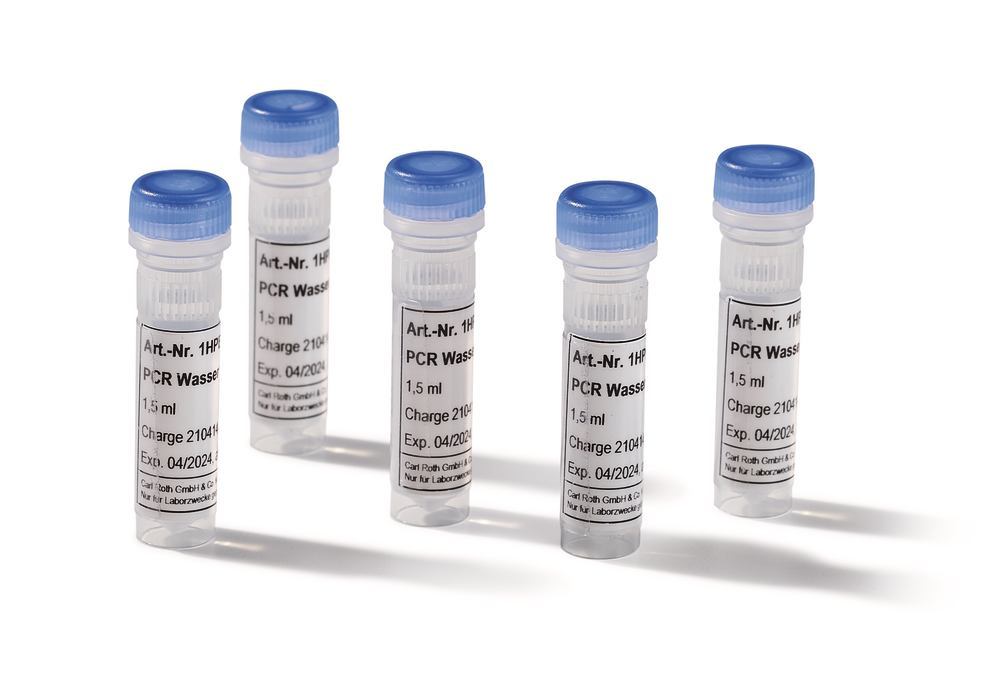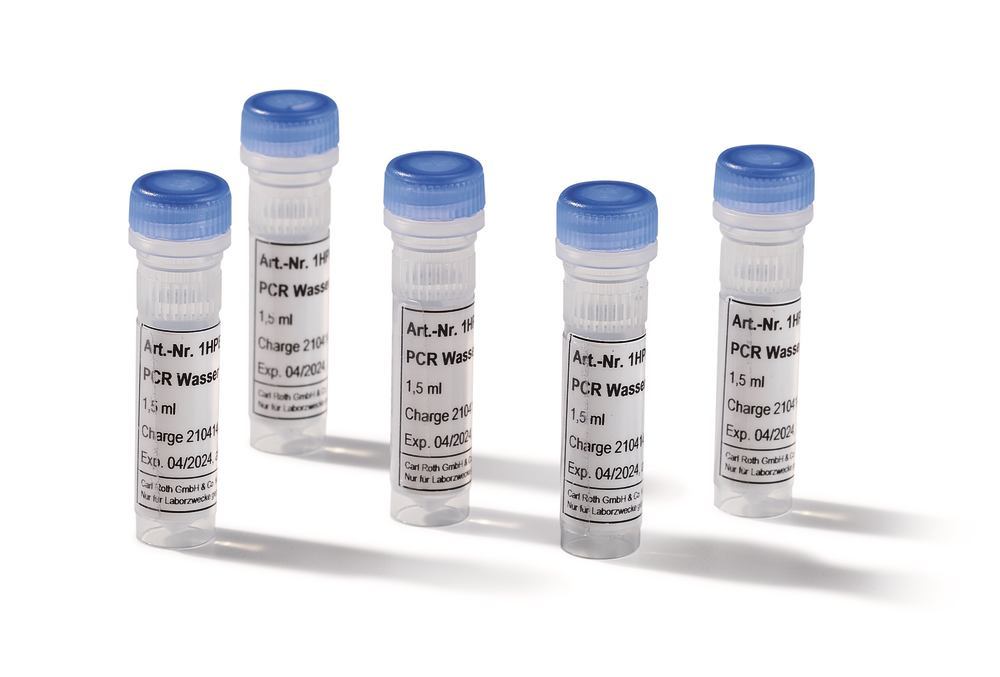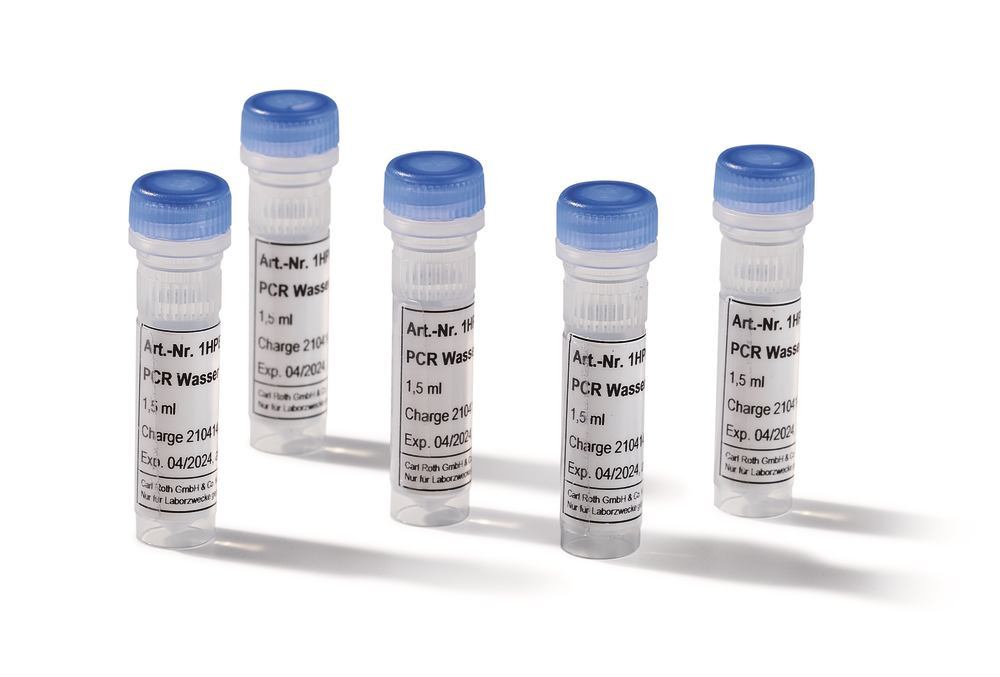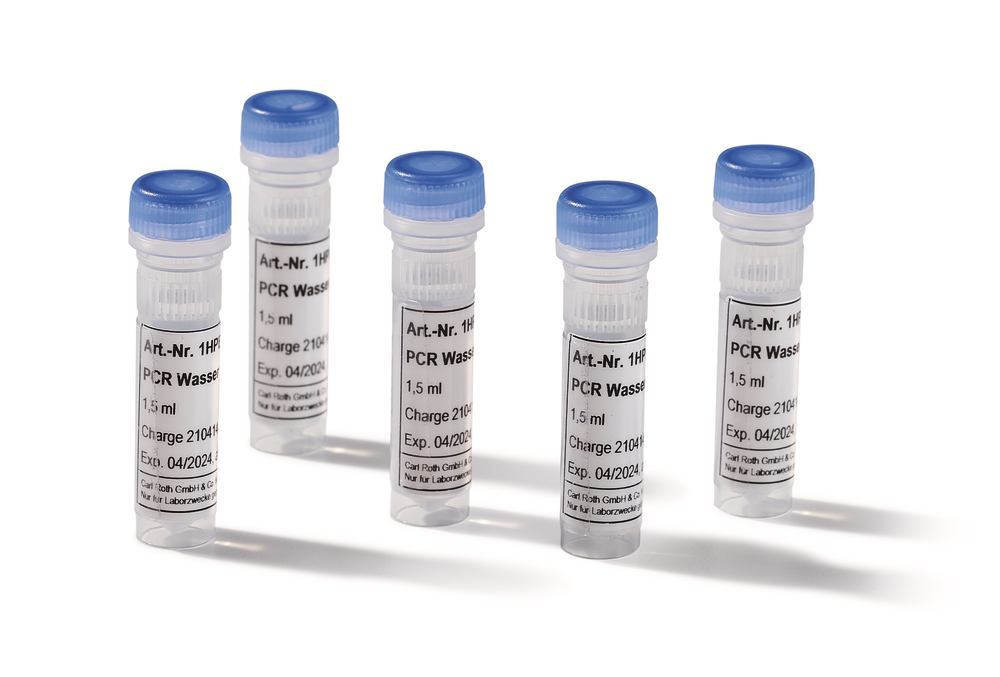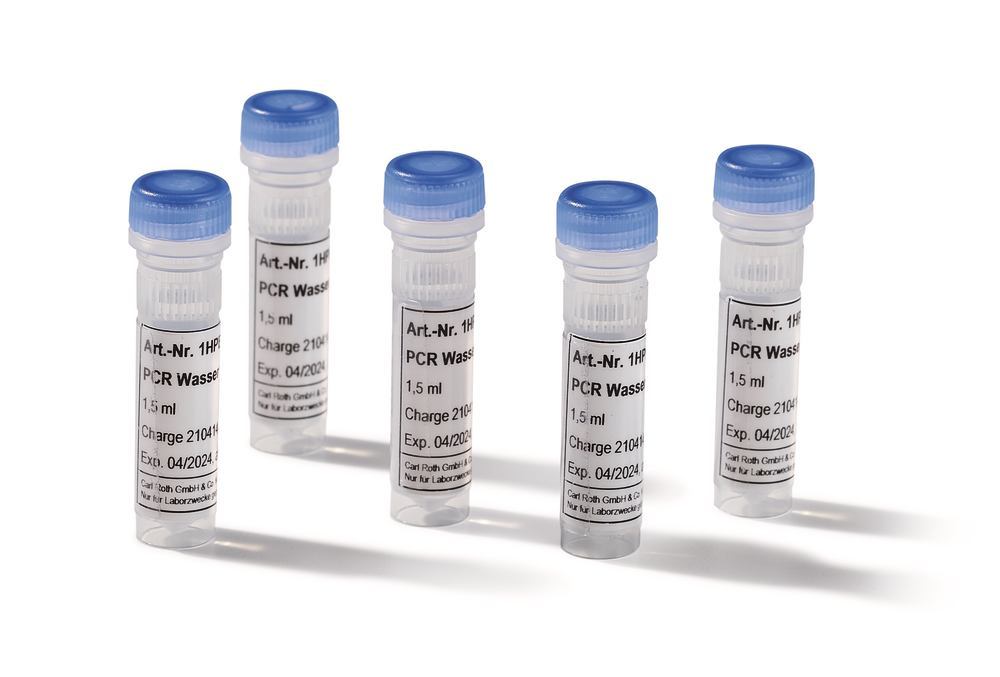

Sterile PCR water Ultrapure water (Type I), sterile, nuclease-free, free of DNA and RNA PCR water is ultrapure water that has been proven to be free of nucleases, DNA and RNA. Ultrapure water is specially purified water whose purity exceeds that of demineralised and distilled water. The difference to the quality of distilled or demineralised water can be seen in the electrical conductivity of ultrapure water of ≤0,075 μS/cm. Since the water molecule is an ampholyte that can react with itself, even ultrapure water has a low electrical conductivity. PCR water is suitable for use in sensitive molecular biology applications such as PCR, RT-PCR, cDNA synthesis or sequencing. Each batch is tested by PCR to exclude contamination by DNA and nucleases.
Mineral Oil for molecular biology Light, colourless oil, particularly suitable for overlaying PCR and other enzymatic reactions such as restriction digestion, priming reactions or whole-mount in situ reactions incubated in warm temperatures. Prevents fluid loss and reduces any danger of cross-contamination. Each batch is functionally tested for its suitability in PCR. Kinematic viscosity of 14-17 mm²/s (40 C).
Sterile Magnesium chloride solution 25 mM, sterile, for molecular biology In a PCR reaction, cofactors such as divalent cations (MgCl 2 ) are needed for an optimal process. Magnesium interacts with the DNA template, dNTPs and the polymerase in a PCR reaction. The MgCl 2 concentration influences the productivity and accuracy of the polymerase. It also influences the binding of the primers to the template. Application: Too high magnesium concentration can lead to reduced specificity and undesired PCR products Too low a magnesium concentration can lead to no PCR product at all Magnesium influences the melting point of double-stranded DNA
Mineral Oil for molecular biology Light, colourless oil, particularly suitable for overlaying PCR and other enzymatic reactions such as restriction digestion, priming reactions or whole-mount in situ reactions incubated in warm temperatures. Prevents fluid loss and reduces any danger of cross-contamination. Each batch is functionally tested for its suitability in PCR. Kinematic viscosity of 14-17 mm²/s (40 C).
Sterile Magnesium chloride solution 25 mM, sterile, for molecular biology In a PCR reaction, cofactors such as divalent cations (MgCl 2 ) are needed for an optimal process. Magnesium interacts with the DNA template, dNTPs and the polymerase in a PCR reaction. The MgCl 2 concentration influences the productivity and accuracy of the polymerase. It also influences the binding of the primers to the template. Application: Too high magnesium concentration can lead to reduced specificity and undesired PCR products Too low a magnesium concentration can lead to no PCR product at all Magnesium influences the melting point of double-stranded DNA
Mineral Oil for molecular biology Light, colourless oil, particularly suitable for overlaying PCR and other enzymatic reactions such as restriction digestion, priming reactions or whole-mount in situ reactions incubated in warm temperatures. Prevents fluid loss and reduces any danger of cross-contamination. Each batch is functionally tested for its suitability in PCR. Kinematic viscosity of 14-17 mm²/s (40 C).
Sterile PCR water Ultrapure water (Type I), sterile, nuclease-free, free of DNA and RNA PCR water is ultrapure water that has been proven to be free of nucleases, DNA and RNA. Ultrapure water is specially purified water whose purity exceeds that of demineralised and distilled water. The difference to the quality of distilled or demineralised water can be seen in the electrical conductivity of ultrapure water of ≤0,075 μS/cm. Since the water molecule is an ampholyte that can react with itself, even ultrapure water has a low electrical conductivity. PCR water is suitable for use in sensitive molecular biology applications such as PCR, RT-PCR, cDNA synthesis or sequencing. Each batch is tested by PCR to exclude contamination by DNA and nucleases.
Mineral Oil for molecular biology Light, colourless oil, particularly suitable for overlaying PCR and other enzymatic reactions such as restriction digestion, priming reactions or whole-mount in situ reactions incubated in warm temperatures. Prevents fluid loss and reduces any danger of cross-contamination. Each batch is functionally tested for its suitability in PCR. Kinematic viscosity of 14-17 mm²/s (40 C).
Sterile PCR water Ultrapure water (Type I), sterile, nuclease-free, free of DNA and RNA PCR water is ultrapure water that has been proven to be free of nucleases, DNA and RNA. Ultrapure water is specially purified water whose purity exceeds that of demineralised and distilled water. The difference to the quality of distilled or demineralised water can be seen in the electrical conductivity of ultrapure water of ≤0,075 μS/cm. Since the water molecule is an ampholyte that can react with itself, even ultrapure water has a low electrical conductivity. PCR water is suitable for use in sensitive molecular biology applications such as PCR, RT-PCR, cDNA synthesis or sequencing. Each batch is tested by PCR to exclude contamination by DNA and nucleases.
Sterile Magnesium chloride solution 25 mM, sterile, for molecular biology In a PCR reaction, cofactors such as divalent cations (MgCl 2 ) are needed for an optimal process. Magnesium interacts with the DNA template, dNTPs and the polymerase in a PCR reaction. The MgCl 2 concentration influences the productivity and accuracy of the polymerase. It also influences the binding of the primers to the template. Application: Too high magnesium concentration can lead to reduced specificity and undesired PCR products Too low a magnesium concentration can lead to no PCR product at all Magnesium influences the melting point of double-stranded DNA
Mineral Oil for molecular biology Light, colourless oil, particularly suitable for overlaying PCR and other enzymatic reactions such as restriction digestion, priming reactions or whole-mount in situ reactions incubated in warm temperatures. Prevents fluid loss and reduces any danger of cross-contamination. Each batch is functionally tested for its suitability in PCR. Kinematic viscosity of 14-17 mm²/s (40 C).
Sterile Magnesium chloride solution 25 mM, sterile, for molecular biology In a PCR reaction, cofactors such as divalent cations (MgCl 2 ) are needed for an optimal process. Magnesium interacts with the DNA template, dNTPs and the polymerase in a PCR reaction. The MgCl 2 concentration influences the productivity and accuracy of the polymerase. It also influences the binding of the primers to the template. Application: Too high magnesium concentration can lead to reduced specificity and undesired PCR products Too low a magnesium concentration can lead to no PCR product at all Magnesium influences the melting point of double-stranded DNA
Sterile PCR water Ultrapure water (Type I), sterile, nuclease-free, free of DNA and RNA PCR water is ultrapure water that has been proven to be free of nucleases, DNA and RNA. Ultrapure water is specially purified water whose purity exceeds that of demineralised and distilled water. The difference to the quality of distilled or demineralised water can be seen in the electrical conductivity of ultrapure water of ≤0,075 μS/cm. Since the water molecule is an ampholyte that can react with itself, even ultrapure water has a low electrical conductivity. PCR water is suitable for use in sensitive molecular biology applications such as PCR, RT-PCR, cDNA synthesis or sequencing. Each batch is tested by PCR to exclude contamination by DNA and nucleases.
Mineral Oil for molecular biology Light, colourless oil, particularly suitable for overlaying PCR and other enzymatic reactions such as restriction digestion, priming reactions or whole-mount in situ reactions incubated in warm temperatures. Prevents fluid loss and reduces any danger of cross-contamination. Each batch is functionally tested for its suitability in PCR. Kinematic viscosity of 14-17 mm²/s (40 C).
Sterile PCR water Ultrapure water (Type I), sterile, nuclease-free, free of DNA and RNA PCR water is ultrapure water that has been proven to be free of nucleases, DNA and RNA. Ultrapure water is specially purified water whose purity exceeds that of demineralised and distilled water. The difference to the quality of distilled or demineralised water can be seen in the electrical conductivity of ultrapure water of ≤0,075 μS/cm. Since the water molecule is an ampholyte that can react with itself, even ultrapure water has a low electrical conductivity. PCR water is suitable for use in sensitive molecular biology applications such as PCR, RT-PCR, cDNA synthesis or sequencing. Each batch is tested by PCR to exclude contamination by DNA and nucleases.
Mineral Oil for molecular biology Light, colourless oil, particularly suitable for overlaying PCR and other enzymatic reactions such as restriction digestion, priming reactions or whole-mount in situ reactions incubated in warm temperatures. Prevents fluid loss and reduces any danger of cross-contamination. Each batch is functionally tested for its suitability in PCR. Kinematic viscosity of 14-17 mm²/s (40 C).